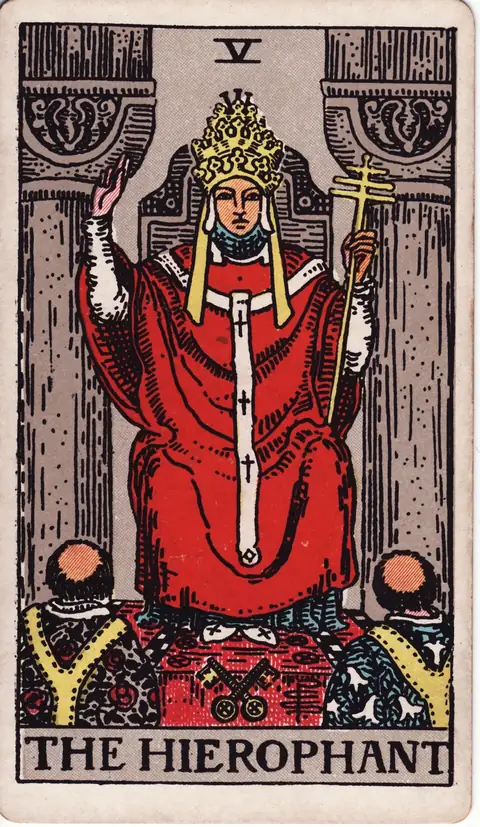
The Hierophant tarot card meaning
The Hierophant upright points to tradition, trusted teachers and shared values, suggesting that a proven path or a wise mentor can guide you well.
- tradition
- guidance
- shared values
- learning
- commitment
| Arcana | Major |
|---|---|
| Number | V (5) |
| Astrology (Golden Dawn) | Taurus |
| Yes or no | Yes upright, maybe reversed |
On this page (12)
What the card shows
A religious figure in a red robe and a tall triple crown sits between two gray pillars, raising one hand in blessing and holding a triple cross in the other. Two tonsured followers kneel before him, one robe patterned with roses and one with lilies, and two crossed keys lie at his feet. The keys are read as access to knowledge passed down, the kneeling pair as students, and the whole scene as teaching within a community and its customs.
The Hierophant upright
The Hierophant represents the knowledge we inherit: from schools, faiths, families and long-standing institutions. When he appears, the card often suggests that following an established route will serve you better than inventing your own right now. That could mean taking a formal course, asking an experienced person for advice or honoring a custom that matters to people you love.
This card also speaks to belonging. The two figures kneeling at his feet are part of something larger than themselves, and there is comfort in that. Upright, the Hierophant can point to ceremonies such as weddings or graduations, to joining a group, or to making a commitment that others witness. It values loyalty, shared beliefs and doing things properly. If you have felt adrift, a teacher, a community or a structured practice may give you the footing you need. Learn the rules well before you decide which ones to keep.
The Hierophant reversed
- rebellion
- rigid rules
- questioning
- going your own way
- conformity
Reversed, the Hierophant often marks a time of questioning. A rule that once made sense may now feel like a cage, or you may be following a path simply because it is expected of you.
This is not a call to reject everything, but to choose consciously. Ask whose voice is really guiding your decision. The card can also point to an unhelpful authority figure or a group that demands conformity. Trust your own values, even if they look different from the norm, and look for mentors who respect that. Your path can still honor the parts of tradition that feel true.
The Hierophant in love
Upright: For singles, the Hierophant can point to meeting someone through a shared community, class or family circle. In a relationship, it favors commitment, shared values and steps such as engagement or marriage.
Reversed, it can show pressure to follow a script that does not suit you both, or clashing values and family expectations. It may also point to a relationship that breaks with convention.
The Hierophant for career and work
Upright, the card favors formal training, established companies and learning from a mentor. Follow the proper process and it is likely to work in your favor.
Reversed, it suggests chafing against rigid rules or outdated methods. You may want a path with more freedom to do things your own way.
The Hierophant as feelings
They respect you and think of you in serious, long-term terms, possibly with an eye on commitment.
The Hierophant as advice
Seek out someone who knows the path, learn from them and honor the commitments you make.
The Hierophant in a tarot reading
The same card reads differently depending on where it lands. These are the readings our spreads use when The Hierophant appears in each position. Try it in a three card reading, Celtic cross.
Upright
| As the past | A tradition, teacher or established path shaped your thinking. Lessons learned through family, school, faith or an institution led you to this point. |
|---|---|
| As the present | Following a proven route will serve you better than inventing your own just now. Formal learning, a mentor or shared values have something real to offer. |
| As the future or outcome | Commitment and belonging lie ahead. You may join a group, take a course or make a promise that ties you to a community and its ways. |
| As the obstacle | Leaning too heavily on rules or other people's expectations may be what holds you back. Doing what is expected is not always the same as doing what is right for you. |
| As advice | Seek out someone who has walked this road and learn from them. Respect the structures that work, and commit to a path with others who share your values. |
Reversed
| As the past | A rule or tradition that stopped fitting sits at the root of this, or a path you followed only because it was expected. Questioning it helped bring you here. |
|---|---|
| As the present | A rule that once made sense may feel like a cage. You are being asked to examine your beliefs and decide which ones are truly yours. |
| As the future or outcome | Your own way is calling. You may step outside convention, find a different teacher or create a path that fits who you have become. |
| As the obstacle | Either rigid rules or reflexive rebellion stands in your way. Conforming to please others and rejecting everything out of frustration are both ways of not choosing. |
| As advice | Ask whose voice is really guiding your decision. Keep the traditions that still serve you, set aside the ones that do not and choose consciously. |
What A. E. Waite wrote about The Hierophant in 1910
Waite designed this deck with Pamela Colman Smith and published its meanings in The Pictorial Key to the Tarot (1910, public domain). His words, as printed:
Divinatory meaning:
Marriage, alliance, captivity, servitude; by another account, mercy and goodness; inspiration; the man to whom the Querent has recourse.Reversed:
Society, good understanding, concord, overkindness, weakness.Modern readers see tradition, teachers and shared values. Waite's list starts with marriage and alliance but also captivity and servitude, and names the man the Querent turns to, while his reversal of concord and overkindness differs from the modern questioning of rules.
Is The Hierophant a yes or no card?
Upright: Yes The Hierophant blesses those who follow a known path, so upright he leans yes for conventional or committed choices.
Reversed: Maybe Reversed, the usual route may not suit you, so the answer is maybe and depends on what you truly value.
Ask your own question with the yes or no tarot. No cards at hand? The yes or no oracle answers with a pendulum.
Learn more: how to read reversed cards, how to read this card with others, whether The Hierophant is one of your birth cards, its astrology correspondence.
Questions
What does The Hierophant mean in tarot?
The Hierophant upright points to tradition, trusted teachers and shared values, suggesting that a proven path or a wise mentor can guide you well. Reversed, the Hierophant suggests rules or traditions no longer fit you, and you may need to question them and find your own way forward. Yes or no: Yes upright, maybe reversed.
What does The Hierophant reversed mean?
Reversed, the Hierophant suggests rules or traditions no longer fit you, and you may need to question them and find your own way forward.
Is The Hierophant a yes or no card?
Yes when upright. The Hierophant blesses those who follow a known path, so upright he leans yes for conventional or committed choices. When reversed, it leans maybe. Reversed, the usual route may not suit you, so the answer is maybe and depends on what you truly value.
What does The Hierophant mean as feelings?
They respect you and think of you in serious, long-term terms, possibly with an eye on commitment.
More Major Arcana cards
 The Fool
 The Magician
 The High Priestess
 The Empress
 The Emperor
 The Lovers
 The Chariot
 Strength
 The Hermit
 Wheel of Fortune
 Justice
 The Hanged Man
 Death
 Temperance
 The Devil
 The Tower
 The Star
 The Moon
 The Sun
 Judgement
 The World
Ready for another reading?
The deck is shuffled fresh for every reading.
Start a free tarot reading