Free palm reading
Look at your hand, pick what you see from clear drawings one feature at a time, and get a full reading of your lines, mounts and thumb. No photo, no sign-up: your choices stay on your device.
Step 1 of 19
Palm reading chart
The chart below shows where everything sits on a right palm, seen the way you look at your own hand. On a left hand every line and mount is in the mirror position. The four main lines are solid, the minor lines dashed, and the mounts are the shaded pads at the base of the fingers and around the edge of the palm.
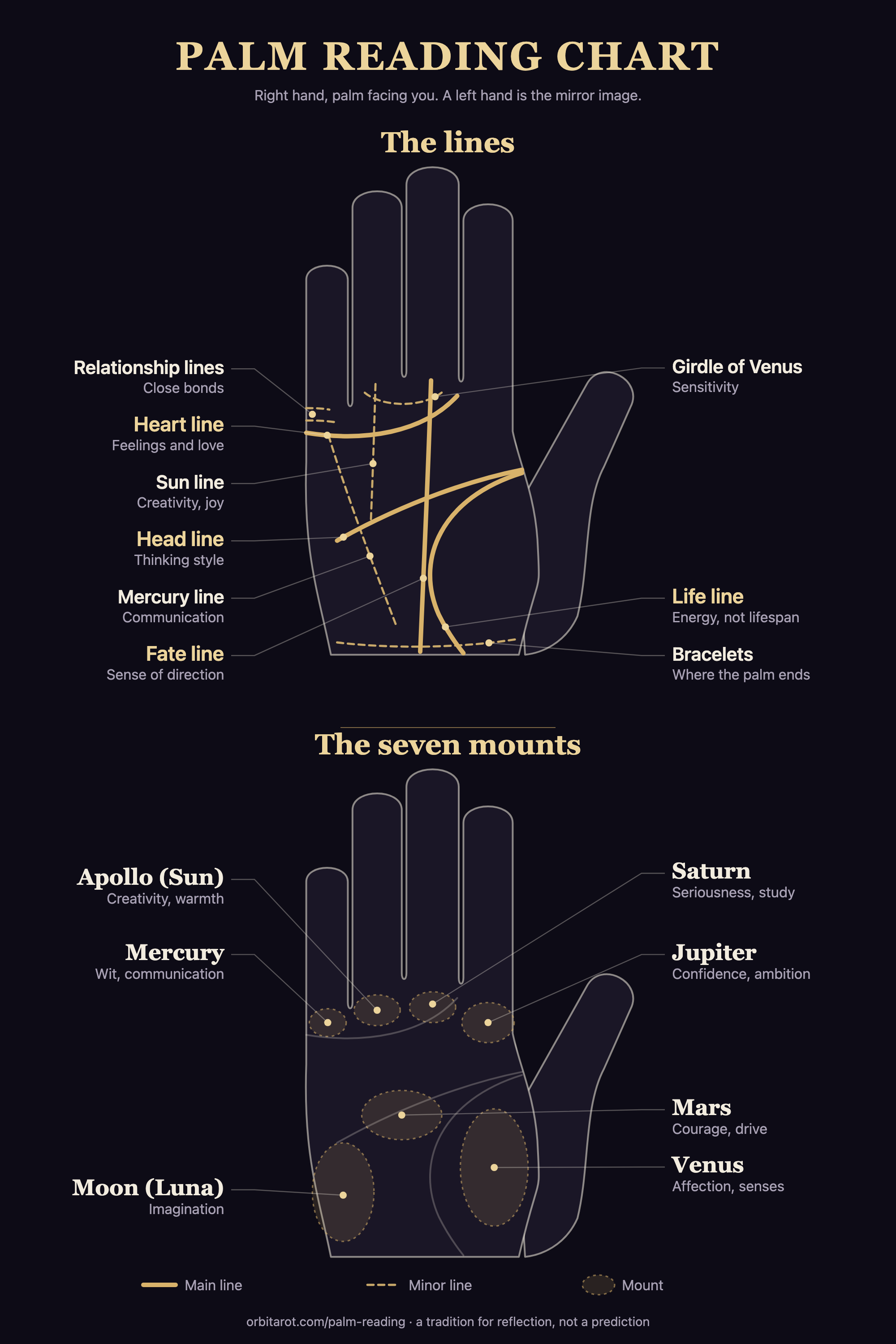
Free to print and share. The PDF is a white version for printing.
How to read your palm, step by step
- Choose a hand. Start with the hand you write with. Palmists read it as the person you have become, and the other hand as where you started.
- Find good light. Daylight from the side shows the fine lines best. Cup your hand slightly: the main lines deepen and the minor ones appear.
- Look at the shape. Is the palm about square, or clearly longer than wide? Are the fingers long or short compared with the palm? Those two answers give the hand type.
- Find the three main lines. The heart line runs across the top of the palm under the fingers, the head line across the middle, and the life line curves around the ball of the thumb.
- Look for the fate line and the minor lines. The fate line runs up the middle of the palm; the sun line up toward the ring finger; relationship lines sit on the outer edge under the little finger. Many hands lack some of them.
- Notice the mounts. Look at the palm from the side and see which pads are fullest.
- Check the thumb. How long is it, and does it bend back easily?
- Compare both hands. Differences between them are where palmists look for change.
The reader at the top of this page walks you through the same steps with a drawing for every choice, then writes the reading for you.
The four main lines
Heart line
The highest of the long lines, running from the little finger edge of the palm toward the index finger. Palmists read it for feelings and the way you love. Where it ends matters most: under the index finger is read as high ideals, between the index and middle fingers as balance, under the middle finger as a more private heart. A curved line is read as feelings that show, a straight one as feelings held quietly.
Head line
It starts between the thumb and index finger and runs across the middle of the palm. It is read for thinking style, never for intelligence. A straight head line is read as logical, a sloping one as imaginative; joined to the life line at the start as cautious, separate as independent. A fork at its end is the writer's fork.
Life line
It curves around the ball of the thumb toward the wrist. Palmists read it for energy, enthusiasm and the big changes in how you live. It does not show how long you live; more on that myth below. A wide curve is read as outgoing energy, a line close to the thumb as a quieter one.
Fate line
It runs up the middle of the palm toward the middle finger, and many hands have none. It is read as your sense of direction and purpose. Where it starts colours the reading: from the wrist (direction found early), from the life line (a path built by your own effort), from the outer lower palm (a path shaped by other people) or from mid-palm (direction found later).
The minor lines
- Sun line (line of Apollo): a line rising toward the ring finger, often short or missing. Read as creativity and the joy you take in your work. Older books tied it to fame and fortune; we leave money out.
- Relationship lines (once called marriage lines): short lines on the outer edge of the hand between the little finger and the heart line. Read as important close bonds. They are not a count of marriages or children, whatever you may have heard.
- Mercury line: a line running up toward the little finger. Read as communication and intuition. Older books called it the health line; we do not give health readings.
- Girdle of Venus: a curved line above the heart line, under the middle and ring fingers. Cheiro described it as a semicircle from the base of the first finger to the base of the fourth. Read as sensitivity.
- Bracelets (rascettes): the creases where the palm meets the wrist. Old handbooks read them for health and long life; we treat them only as the bottom edge of the palm.
The seven mounts
The mounts are the fleshy pads of the palm, named after the seven classical planets. Palmists look at which ones are full and which are flat.
| Mount | Where | Read as |
|---|---|---|
| Jupiter | Under the index finger | Confidence, ambition, leadership |
| Saturn | Under the middle finger | Seriousness, study, responsibility |
| Apollo (Sun) | Under the ring finger | Creativity, warmth, love of beauty |
| Mercury | Under the little finger | Wit, communication, persuasion |
| Venus | The ball of the thumb | Affection, warmth, love of the senses |
| Moon (Luna) | Outer edge, lower palm | Imagination, intuition, inner life |
| Mars | Middle of the palm and the pads beside it | Courage, drive, resilience |
Some palmists split Mars into three: an inner Mars just above the thumb, an outer Mars on the opposite edge, and the plain of Mars in the hollow between them. The reader above keeps them together.
The four hand shapes
Most palm readers today sort hands into four types named after the classical elements, using just two measurements: the shape of the palm and the length of the fingers.
| Type | Palm | Fingers | Read as |
|---|---|---|---|
| Earth | Square | Short | Practical, steady, loyal |
| Air | Square | Long | Curious, talkative, analytical |
| Fire | Long | Short | Energetic, enthusiastic, impulsive |
| Water | Long | Long | Sensitive, imaginative, empathic |
The element system is newer than many people think. Cheiro, writing in 1916, still sorted hands into seven types: the elementary, the square, the spatulate, the philosophic, the conic, the psychic and the mixed hand. Real hands rarely fit one box, so if yours sits between two types, read both.
Which hand to read: dominant or non-dominant
Palmists read both hands and give them different jobs. The hand you write with is read as the self you have developed: habits, choices, the present. The other hand is read as your starting point: inborn inclinations. Cheiro, who assumed a right-handed reader, put it this way in Palmistry for All (1916): the right hand "denotes the developed or active brain, the left only giving the natural tendencies or inclinations." For a left-handed person the roles swap.
Start with your dominant hand, then run the reader again on the other one and compare. Where the two hands agree, palmists consider the reading stronger; where they differ, they look for a change you have made.
The life line does not show how long you live
This is the most common fear about palm reading, and it has no basis. A short, broken or faint life line does not mean a short life. Even in 1900, William G. Benham opened The Laws of Scientific Hand Reading with a request to his readers: "I ask that you will never predict the death of anyone nor its date."
The lines themselves are skin creases. The main palm creases form before birth, in the developing hand (Kimura, 1991), and anatomists describe their job as letting the skin of the palm fold when the hand grips (Park and colleagues, 2010, from the palms of 3,216 people). That is why palmists today read the life line for energy and the big changes in how you live, never for lifespan or health, and why this page does the same.
A short history of palm reading
Palm reading has been practised in many cultures across Europe and Asia. In India it belongs to Samudrika Shastra, the Sanskrit study of marks on the body, with medieval Sanskrit texts devoted to the lines of the hand. In 15th-century Europe, Johannes Hartlieb's Book of All Forbidden Arts (1456) listed chiromancy among seven forbidden arts of divination, and in the 16th century the Catholic Church condemned the practice.
The modern revival began in France with Casimir d'Arpentigny's La Chirognomie (1839), a study of hand shapes. In England, Edward Heron-Allen published Palmistry: A Manual of Cheirosophy (1883), and the Irish palmist William John Warner, known as Cheiro, read for celebrities from Mark Twain to Oscar Wilde. Cheiro's thumb chapter repeats d'Arpentigny's line that "the thumb individualises the man." In the United States, Benham's 1900 book tried to put the subject on a scientific footing; his stated goal was to "lift it from its position as an effete superstition, and place it among the modern sciences."
That goal was never reached. The psychologist Ray Hyman, who read palms for money as a young man and came to believe in it, later described an experiment suggested to him by the mentalist Stanley Jaks: he gave clients readings that said the opposite of what their lines indicated, and the readings were just as successful as before. Hyman told the story in "Cold Reading" (The Zetetic, 1976-77), an essay on how a reading can convince reader and client alike.
A tradition for reflection, not a prediction
Scientists class palmistry as a pseudoscience: there is no evidence that the lines of the hand predict events, and different schools often read the same line in different ways. We present palm reading the way we present tarot: as a tradition with a long history and a useful vocabulary for thinking about yourself. A reading can prompt a good question; it cannot tell you what will happen.
So the readings on this page describe temperament as the tradition sees it and never forecast events. They say nothing about health, lifespan, pregnancy or children, money or legal matters, because no hand can. The texts are our own, written from the common teachings of the classic books and modern practice; where palmists disagree, we give the most widely used reading.
Sources
- Cheiro, Palmistry for All (New York: G. P. Putnam's Sons, 1916), Project Gutenberg; quotes checked against the archive.org scan.
- William G. Benham, The Laws of Scientific Hand Reading (Putnam, 1900), Introduction; quotes checked against a 1912 printing.
- S. Kimura, Embryologic development of flexion creases, Birth Defects Original Article Series 27(2), 1991.
- J. S. Park, D. S. Shin, W. Jung and M. S. Chung, Improved analysis of palm creases, Anatomy & Cell Biology 43(2), 2010.
- Ray Hyman, "Cold Reading: How to Convince Strangers That You Know All about Them", The Zetetic 1(2), 1976-77.
- Wikipedia, Palmistry (history: Samudrika Shastra, Hartlieb, d'Arpentigny, Heron-Allen, Cheiro, Benham).
- The chart and every drawing on this page are our own.
Questions
Is palm reading accurate?
Not in the sense of predicting anything. There is no scientific evidence that the lines of the hand foretell events, and palmists themselves disagree on what many lines mean. What a palm reading can do is offer a structured way to think about your temperament: you compare the tradition's description with what you know about yourself. Treat it as a mirror, not a forecast.
Which hand do you read in palmistry?
Both, starting with your dominant hand, the one you write with. Palmists read the dominant hand as the person you have become and the other hand as your natural starting point. If you are left-handed, your left hand is the dominant one.
Can the lines on your palm change?
The main creases form before birth and keep their basic layout. Palmists have long held that the finer lines change over the years, which is why many like to compare readings taken years apart. Reading both hands is the usual way palmists look for change: the dominant hand is read as what you have made of your starting point.
What if I do not have a fate line, or another line is missing?
That is common and not a bad sign. Many hands have no fate line or sun line at all, and Cheiro wrote that some people "seem to carve their Destiny from day to day". In the reader, choose the option for no line or skip the step.
Does a short life line mean a short life?
No. The life line does not show how long anyone lives; that is a myth, and no line on the hand can show it. Palmists read the life line for energy and the big changes in how you live.
What does an M on the palm mean?
Some people's heart, head, life and fate lines together form a letter M. Popular modern lore links it with intuition and drive, but the classic handbooks we checked (Cheiro 1916, Benham 1900) do not mention it, so it is a recent idea rather than an old tradition.
Do you store my palm reading?
No. Your choices stay in your browser. The share link carries only the options you picked, never a photo or your name, and a reading is saved only if you press Save to my journal, which keeps it on this device.
More readings
Ready for another reading?
The deck is shuffled fresh for every reading.
Start a free tarot reading